



Centrifugal Pump Design: Why I Start with Mechanical Constraints Before Hydraulics
Discover a proven workflow for impeller design. Learn why prioritizing shut-off head and cavitation prevention is crucial for building reliable industrial pumps.
Eng. Homam Alhelwani
3/9/20261 min read
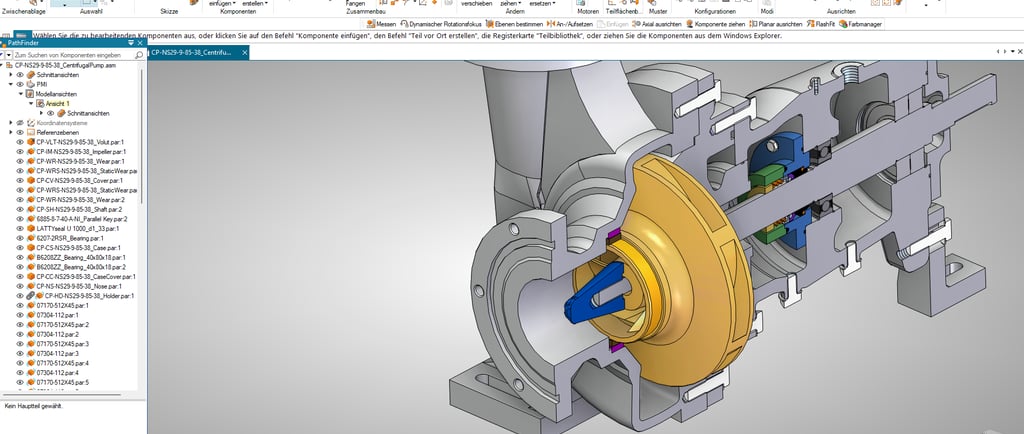
Why I start with Mechanical Constraints before Hydraulic Profiles:
Designing a robust impeller goes beyond just hitting the Best Efficiency Point (BEP). It requires balancing hydraulic performance with mechanical reliability from step one.
Here is a critical insight from my workflow regarding Shut-off Head (H0) and Suction Geometry:
Safety First (H0): I prioritize calculating the Shut-off Head pressure (H0). This value dictates the maximum mechanical stress on the casing and shaft. I use the recommended H0/H ratio (typically between 1.1 and 1.3 depending on pump type) to constrain the Outer Diameter (d2) early in the process.
Cavitation-Free Inlet: The Inner Diameter (d1) and Inlet Angle (β1) are derived strictly from suction criteria (NPSH) to prevent cavitation, not just geometry.
The Iterative Loop: Hydraulic equations are empirical approximations.
My process involves an iterative loop of calculation leftrightarrow simulation until the parameters converge, ensuring reliability and accuracy.
My Full Workflow Summary:
Requirements: Defining Q, H, density, viscosity.
Specific Speed ($n_q$): Validating pump type (Radial/Mixed/Axial).
1D Design (Gülich): Calculating main dimensions ($d_2, b_2, \beta$, blades).
3D & CFD: Parametric modeling (Solid Edge/Inventor/Catia) followed by flow simulation (Q-H, Efficiency, Pressure Pulsations).
Prototype Testing: Building a physical prototype to validate design calculations and CFD predictions under real operating conditions. This step ensures the pump performs as expected and identifies any unforeseen mechanical or hydraulic issues.
Documentation: Comprehensive documentation of design, calculations, simulations, and test results to ensure reproducibility, support maintenance, and serve as a reference for future projects.
Designing this way ensures the pump doesn't just "work" in simulation, but survives in the real world.
Contact
Eng. Homam Alhelwani
Email: info@hme-alhelwani.de
Mobile: +49 15753239933
© 2026 Eng. Homam Alhelwani. All rights reserved.
Hubertusstraße. 12-14
52064 Aachen
Germany